Tuesday, June 9, 2009

Ultimate locavore club - CSA's

Have you ever wanted to support your local agriculture, but don't know how?  Have you wanted to get your fruits and vegetables at the peak of freshness?  Maybe you want to reduce your ecological footprint in obtaining your food?  Or maybe you just want to find more interesting varieties of produce and meat?  Well, then you should look into Community Supported Agriculture, or CSA's.

What is a CSA, you might ask?  Well, I'm not going to say there are hard and fast rules, to be sure, but normally, a CSA is a family farm, or small group of farms.   You purchase a membership, or share, in the CSA, usually paid for in an upfront fee.  In return, you are guaranteed a regular share of whatever that farm is producing.  Most CSA's supply produce, although there are ones that sell eggs, milk, free range chickens, and even beef, pork, etc.  Produce CSA's typically have a weekly pickup, and members will receive whatever is at its peak that week.  Many CSA's raise their produce sustainably and organically, though often, they are not certified due to the increasing governmental fees and regulations for organic certifications that benefit corporations at the expense of family farms.  

How can I join a CSA, you might ask, and how can I find one in the first place?  Well, finding CSA's is a reasonably easy task.  One of the quickest ways is to visit Local Harvest, a website dedicated to promoting local agriculture in the form of CSA's, farmers' markets, etc.  Many, many CSA's use the site to promote themselves.

Joining a CSA can be a little trickier.  There is, after all, only so much that any farm can produce, and many CSA farms are geared towards quality, not quantity.  Because of this, CSA membership is limited, and more popular ones can have long waiting lists.  I have been on a waiting list for a fruit CSA for over a year, and I can only hope that I will have a chance to get in next year.  The good news is that new CSA's are springing up all the time.  Additionally, many CSA's also sell at some farmers' markets, so you can have an opportunity to sample the produce from different farms before making your decision as to which CSA to try to join.   Most CSA memberships fill up before the growing season starts, so it is probably too late to join one this year (though it never hurts to ask).  However, if you find one that you like, you can definitely get on the list for next year.

There are also CSA's that will sell to the general public from their farms, and though you aren't guaranteed specific items, and will perhaps pay more than you would if you were a member, it is still a good way to explore whether you would like to join later.

CSA's are a wonderful way to get the best of what is fresh now, to find produce and other products that are rare in commercial markets, and to obtain high quality food for incredible prices.  I highly urge you to check out what's in your area!

Thursday, June 4, 2009

Wonder bacteria...


You probably don't like to think about bacteria and food.  After all, if you've ever opened up a container of food and smelled an unpleasant aroma emanating from it, you've experienced bacterial growth in action.  However, bacteria are responsible for giving us some of our most delicious foods - among them,chocolate, cheese, yogurt, bread, and alcoholic beverages.  

The main type of bacteria that you can thank for this wonder is lactobacillus.  We have a fairly symbiotic relationship with lactobacillus.  There's some living in your gut right now.  This is why pro-biotics can help with digestion.  Lactobacillus breaks down sugars that we are unable to digest - sugars like lactose, from which its name is derived.  

Of course, lactobacillus is inherently tied to dairy.  One species or another is responsible for most most fermented dairy products - cheese, sour cream, creme fraiche, and yogurt are all different varieties of lactobacilli.  Lactobacillus is also present in sourdough, where it exists in symbiosis with yeast.  Lactobacillus works so well because it produces lactic acid as a byproduct.  Most bacteria don't survive well in an acidic environment, and so they are unable to form colonies.  Yeast is a rare bacteria that does fare well, which is how it is able to co-exist so happily with lactobacillus.

If you have a mother culture, it is pretty easy to keep it going.  In the case of commercial strains of lactobacillus, these strains are easily obtainable.  In the case of creme fraiche, simply add a splash of buttermilk to heavy cream, leave it in a warm place until thickened, and pour off the liquid that has separated out.


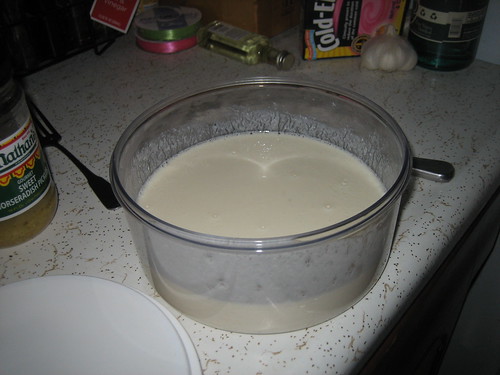
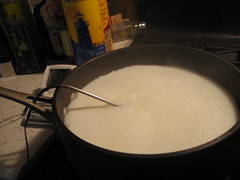
Yogurt is also ridiculously simple to make.  Scald some milk, let it cool to the point where it is hot, but not burning you, and whisk in some yogurt.  


Let it sit in a warm place (if you have a warming drawer in your oven, this works great; there are also commercial yogurt makers) until it thickens, then pour off the liquid that has separated.  Now you have yogurt that costs about half or less what you would have paid for it at the grocery store.


Furthermore, if you then take that yogurt, put it in cheesecloth, and hang it for an hour or two, you'll be left with yogurt cheese, a thick, creamy spreadable substance, that, when mixed with herbs and drizzled with olive oil, yields a wonderful spread for sandwiches, or just plain enjoying on pita.

Tuesday, June 2, 2009

Focus on producers - Crump Family Gardens

For my first focus on a local food producer, I conducted a brief interview with Bob and Joanne Crump, who run the Crump Family Gardens stand at the Metro Centre farmer's market.  The Crumps show up on the first of May and stay for pretty much the entire run at Metro Centre.  

The Crump family farm, which they run along with their son Bryan, is located near Carlock, IL.  They have been farming the same land for the last 21 years. Bob uses organic and sustainable practices to produce their vegetables, but as the neighbors do not, they are not able to gain certification of any sort at present.  They are a focus farm, with a few crops that they specialize in.  At present, many of those crops are not ready, so you will find a fair amount of things that are trucked in from more southern locales, but they do have some excellent early crops, in the form of asparagus, rhubarb, and greens (both lettuce and spinach).  They are also a supplier of southern Illinois strawberries.  

Later on in the season, you will be able to find an excellent selection of their focus crops.  The Crumps grow several tomato varieties, although most are conventional hybrid tomatoes.  They supply several area businesses with summer tomatoes, such as The Firehouse and The Butcher Block.   

The Crumps also put a heavy focus on peppers.  Although Bob couldn't give me the number of varieties that they grow, he did say that they put in 2700 pepper plants this year.  They grow both mild and hot varieties.  

You will also find a few varieties of potato, such as Yukon Golds and Reds, as well as summer and fall squashes, cucumbers, and a variety of herbs, all grown on the Crump farm.

I asked Bob what it was about farming that he enjoyed most, and he told me "I love being out in the field, it's quiet, and I can work at my own pace."  However, he also loves coming to the farmer's markets and interacting with his customers, which explains why the Crumps also maintain stands at the Normal, Lincoln, DeKalb, and Sycamore farmer's markets.  

Overall, the Crumps have a commitment to producing quality local food because they love working the land.  They may not have the flashiest varieties of produce, or subscribe to a particular philosophy of food that is currently trendy, but they want to sell consumers good produce at a good price.  I highly recommend checking out their stand the next time you are at the Metro Centre market.

Friday, May 29, 2009

Sour, Stalky, Sublime - Rhubarb

One of the first signs of spring, for me, was the sight of the rhubarb plants in our garden, knobbing up out of the dirt.  Then, we only had to wait until enough long stalks supported elephantine leaves before we could harvest them.  

Rhubarb is one of those plants that one has to wonder why we ever started eating it.  I mean, the leaves are poisonous, the stalks are so sour that they leave your face puckered, and it's a bit tough and stringy, to boot.  To be fair, we didn't eat it for a long time.  Rhubarb was primarily used medicinally until the 17th century, which coincided with the advent of cheap sugar (and an increase in cavities).  It appears to have become an extremely popular form of dessert in England, where they appreciated tartness.  In fact, a popular method of eating rhubarb, from then through the present day, is simply to dip the stalks directly into granulated sugar for each bite.

Rhubarb's popularity continued in the U.S. when English settlers brought it with them.  Since it is a perennial plant, and requires little care, it tended to spread with the ever-westward moving Americans.  Rhubarb's popularity peaked in the WWII and postwar period, and it has declined ever since, especially as more and more Americans have flocked to cities and abandoned their gardens, forgetting about this once ubiquitous plant.  However, with the ever increasing popularity of farmers markets', people are re-discovering rhubarb in great numbers every year.  It has also become a popular featured item on seasonal restaurant menus across the nation.  

Rhubarb may be tough and stringy when raw, but cooked rhubarb becomes wonderfully tender.  With the right blend of sugar, it is imbued with the perfect balance of sour and sweet for a dessert or a savory sauce.  Many people like to pair it with other sweet fruits for a more balanced flavor profile, strawberry rhubarb pies and jams being one of the most popular combinations.  I, myself, am a rhubarb purist.  I consider the finest expression of rhubarb to be my mother's rhubarb custard pie, which I make faithfully every year.

Rhubarb-Custard Pie

1-1/2 c sugar
1/4 c flour
1/4 tsp nutmeg
dash of salt
3 eggs
4 c rhubarb
2 tbsp butter

Mix dry ingredients together.  Beat egg just until smooth & add to dry
ingredients.  Stir until smooth.  Stir in rhubarb until coated.  Line
pie pan with crust.  Pour in rhubarb mixture.  Dot with chunks of
butter.  Top with lattice crust & seal.  Bake at 400 F for 50 minutes.


Or, you could go with another dessert favorite, rhubarb crisp.

Rhubarb Crisp

4 c. rhubarb
1/2 tsp salt
1-1/3 to 2 c. sugar (to taste)
3/4 c. flour
1 tsp. cinnamon
1/3 c. butter
1/2 c. toasted almonds (optional)

Mix salt, sugar, flour, & cinnamon.  
Cut butter into mixture so it's crumbly.  Add almonds.  
Put Rhubarb in 8x8 pan.  Sprinkle topping over rhubarb.  
Bake at 350 for 40 to 50 minutes.


There are, of course, endless variations that you can do with either of these recipes (personally, I think that rhubarb and cardamom would pair well), and I like the idea of baking the crisp in individual ramekins and serving with a scoop of ice cream.

There are some savory applications as well - for instance, a fattier meat, such as pork or duck, would pair well with a rhubarb based sauce.  I have also seen several blog posts for making things such as rhubarb simple syrup.  The point is, there are endless variations that you can make, but you'd better do it soon, before the rhubarb season is over.  So whether you get it from the farmer's market, or Schnuck's, or wherever, enjoy it while it lasts.

Thursday, May 21, 2009

Lots of spring things!

First off, I apologize for my absence.  Things have been busy.

Back to business...avocado season is in full swing in California right now, which means that here in the midwest, they are marginally cheaper, but much, much nicer. 

Rhubarb is in full stalk as well.  One of my favorite spring treats, rhubarb is tart and tangy, and makes a great pie, cake, or even savory compote to pair with pork.  

Look for strawberries to be coming to Metro Centre this Friday.  I have it on good authority that southern IL berries will be there and ready.

Finally, it is soft shell crab season.  They will probably be in and affordable for the next 3-4 weeks.  Make sure that they are alive before you purchase them.  Or, alternatively, you can come get them from my restaurant, which I should probably plug.  Chef John's Wine Bar and Grill in Dunlap, off of Rt. 40.  I have 6 crabs left, but I'll be getting in more next week.

I will be putting in full posts about several of these things, and I will be trying to bring you some of a planned series of great foodie businesses in Peoria very soon.

Cheers!

Tuesday, May 12, 2009

Sweeter Side of Spring - Vidalias


I want to start off by saying that I LOVE onions.  If you don't, you probably shouldn't waste your time reading this, but seriously, if you don't love onions, then what the heck is wrong with you?

Onions are one of those vegetables that you will find stretched across the globe, in one form or another.   This is partly because onions, properly dried and cellared, keep well, and thus made a useful long-storing crop for the parts of the globe with more temperate climates.  Equally important to the onion's success as a food crop, however, would be the strong yet pleasant flavor associated with onions.  Certainly, they are an important enough foodstuff that they have had religious symbolism painted on them since the time of the Egyptians.

Obviously, with so many varieties of onion in the world, there are many unique flavors and textures.  Certainly, no one would eagerly substitute a shallot for a scallion, or a leek for a Bermuda.  But what is it that makes the Vidalia different from all those other yellow onions, like Spanish or Walla Walla's?

Well, first of all, most standard "onions" (white, yellow, Bermuda), are actually quite high in sugar content.  This is easily demonstrated by making caramelized onions of any variety.  Cook them for long enough over gentle heat, stirring occasionally, and you will be rewarded with a wonderfully sweet and dissolving golden brown mass.  Of course, this takes a great deal of time and attention, and all the texture of the onion is lost, as well as most of the "onion-y-ness" inherent to the species.  

On the other hand, a raw, or quickly sauteed onion can be quite sharp and pungent.  Anyone who has ever taken their knife to one has experienced "onion tears".  This is due to the fact that the other thing onions are notably high in is sulfur, which it easily absorbs from the soil.  No matter what old wives' tale you try to combat onion tears, the fact is that once you cut an onion, sulfur released from it combines with oxygen to form Sulfur Dioxide, which irritates our mucous membranes, causing tears and sniffling.  

Enter the sweet yellow onion family, with several varieties grown in different regions of this country, the aforementioned Walla Walla being one.  These onions have been bred to be milder, or in other words, to absorb less sulfur from the soil.  This allows your palate to taste more of the sugar, making them appear "sweet".  

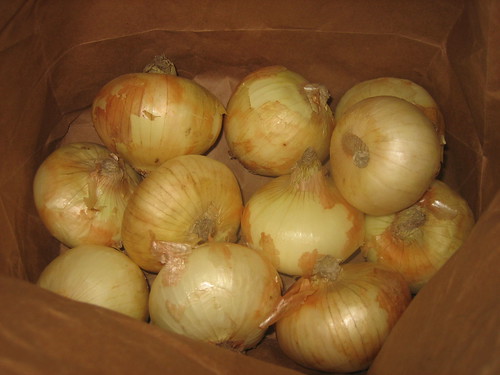
So why is the Vidalia superior to other types of sweet onion, you might ask?  Well, it's got a couple of things going for it that other onions don't.  The most important one is that the region of Georgia where Vidalia's are grown has a soil that is uniquely low in sulfur.  This means that you taste even more of the natural sugar in the onion than the regular sweets.  If an onion is called a Vidalia, it must come from a very specifically defined area that covers about 17 counties in Georgia.  Otherwise, it legally cannot be sold as a Vidalia.

Ironically, the other reason that Vidalias are higher quality is because of their name.  Let me clarify that statement.  Vidalias have been around since the 1930's at least, but it wasn't until 1976 or so that the general American public became aware of them.  This is due to the fact that a peanut farmer turned politician had recently won an election.  That man, of course, was Jimmy Carter, and he imported Vidalia onions to the White House, bringing them to the general public's attention for the first time.  This timing happened to coincide with the explosion of the Nouvelle American cuisine movement, and Vidalia onions became a poster ingredient for the new food movement.  Combine that with an extremely limited availability (Vidalias are only harvested between mid-April and June) and suddenly, you have a new gourmet product that the public demands quality from.  Since the farmers in the Vidalia region are able to charge a premium price for these onions, they are able to keep quality standards, such as hand harvesting, in place.  

All of this combines to continue to make the Vidalia one of the best quality ingredients that is produced for a large scale audience.  We are currently in the midst of the Vidalia season, so please, seek them out and enjoy them.  One of my favorite things to do with them is onion rings - soak them in buttermilk, then toss in seasoned flour and fry.  


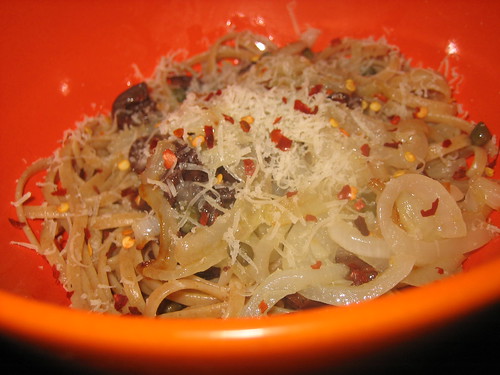
As an alternative suggestion, saute the onions gently in olive oil until they begin to brown.  Add a few olives, capers, and some fresh lemon juice, pour over whole wheat pasta, and top with Parmesan reggiano and red pepper flakes for a quick, easy way to enjoy these onions at their finest. 

Sunday, May 10, 2009

Eggy goodness


Eggs are loved by nearly everyone.  We use them as a stand alone dish, to enrich or emulsify sauces, and as a major ingredient of most of our favorite desserts.  No matter what part of the world you're in, eggs find their way into the local cuisine.

Unfortunately, in recent years, eggs have gotten a bad rap.  Due to the fact that yolks have higher levels of cholesterol than many foods, doctors warned their patients not to eat eggs very often, for fear that their would raise already high cholesterol levels.  Of course, this science turned out to be alarmist and wrong, but the mindset stuck, and millions of Americans still think that eating too many eggs is a dangerous thing, health-wise.  So people stay away from eggs entirely, or eat egg whites to avoid the "bad" parts of the egg.

In actuality, the egg yolk is probably the healthiest part of the egg to imbibe.  Eggs are one of the highest quality sources of protein in existence.  It makes sense if you think about it - eggs contain the components necessary to create a fully living being.  The white is simply the food that being needs to eat while forming.  So please, don't be afraid of your egg yolk.  It's good for you!

Now, this is not to say that all eggs are created equal.  Nutrition and sustainability are still concerns for your eggs.  At the bottom of the totem pole, we have factory farmed eggs.  Yes, they're cheap, but at a cost.  The yolk has the lowest concentration of nutrients, due to the diet that the hens eat.  They're trucked  in from hundreds of miles away, which leads to pollution.  The factory farms on which they're raised also lead to massive levels of chicken waste, hence, more pollution.  The same farms often employ illegal immigrants or use other abusive labor practices, leading to exploitation of their workers just so that you can have a cheap egg.  And finally, the hens that lay the eggs have some of the most miserable lives you can possibly imagine for any animal, as they are kept in a tiny cage for their entire life, and we'll just say that they do some not very nice things to keep them that way.  So, if any of the above things concern you, you may want to consider avoiding conventional eggs.

Now, if you weed out these selections, you're left with a few other grocery choices - organic, omega, brown, cage free, and free range being the most common, and usually found in some combination.  A brief explanation of these terms: organic and omega eggs refer to the diet that the chicken was fed - organic grains, and in the case of omega, flaxseed and other things that will raise the proportion of Omega-3 oils found in the egg yolk.  Brown eggs are simply laid by a variety of chickens that fell out of favor for a while.  There is nothing particularly special about them otherwise.  

Cage-free and free range refer to the fact that the chickens are allowed to roam and peck their food.  Cage free chickens, as the name would imply, are not kept in cages.  However, they still may be kept in an enclosure with hundreds of other chickens, which is less inhumane than cages, but still only a minor improvement.  Free-range means that the chicken had access to the outside - however, this does not mean that the chicken actually gets to walk around looking for its food.  These terms once meant something, but due to corporate pressure on the government to define these terms, one must research the farm to find out exactly how the chickens are actually treated.  

So what's a consumer to do?  Well, due to the locavore food movement, farm fresh eggs are making a comeback.  Most of these farms raise true free-range chickens, which means that the chickens are allowed to roam for their food, which may or may not be supplemented with food by the farmer.  The advantages of buying farm fresh eggs are several.  The eggs are coming from only a few miles, the chickens are being raised in a sustainable (and often, from a pest control standpoint, ecologically friendly) method, the farm labor is usually paid fair wages, and the eggs have a higher nutrient density, as well as a flavor that will be unique to your local area.  

What this means to you as a consumer is that you will probably pay a couple of bucks more for a carton of eggs, but you are getting quality unseen in the grocery store, and you are supporting local agriculture, which is good for your community for the myriad of reasons listed above.  

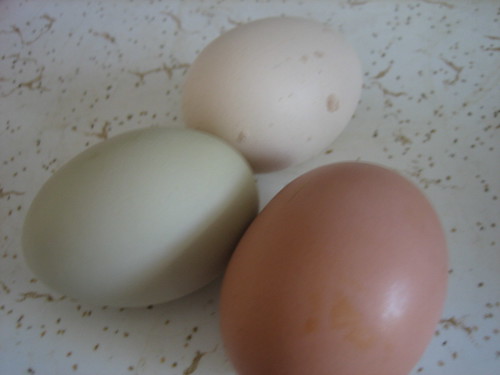
But where do I find these farm-fresh eggs, you might ask?  Well, farmers' markets are an excellent place to start.  You will probably get the very freshest eggs by doing this.  Natural food stores are also a good place to look.  Here in Peoria, Greengold Acres (in Hannah City, near Wildlife Prairie Park), is one farm that supplies farm-fresh eggs.  Currently, I know that they sell eggs at the Pekin Farmer's Market on Rt. 9, but I swear I read somewhere that they also will be at the Peoria Heights Farmer's Market, which starts in June.  However, I discovered, to my delight that, you can purchase their eggs through Naturally Yours, the natural grocery in Metro Centre.  The eggs pictured above are all from the same carton.

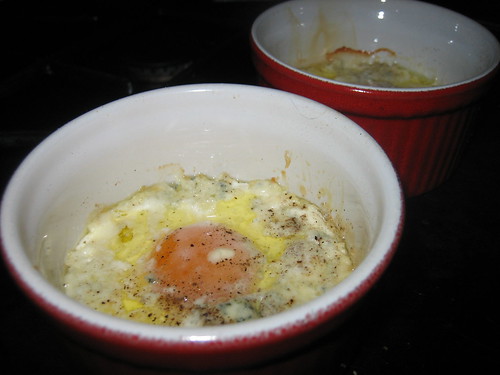
Now, if you've gone through the trouble of getting farm-fresh eggs, you might ask yourself what to do with them.  I went for a preparation that would showcase them in their simplicity - shirred eggs.  They're quite simple to make, really - just preheat your oven to 375 degrees, and melt some butter in a ovenproof cup or ramekin.  Throw in a splash of cream, crack in the egg, and season them with salt and pepper, and maybe a little cheese. I used blue here, but I think that it was overpowering for the delicacy of the egg flavor.  Bake the eggs for 15 to 20 minutes, until is is almost set in the center.  Enjoy.

The flavor of these eggs was really incomparable, with a grassy, almost floral aroma that I've never noticed in an egg before.  I highly recommend seeking out some farm fresh eggs for yourself.