Eggs are loved by nearly everyone. We use them as a stand alone dish, to enrich or emulsify sauces, and as a major ingredient of most of our favorite desserts. No matter what part of the world you're in, eggs find their way into the local cuisine.
Unfortunately, in recent years, eggs have gotten a bad rap. Due to the fact that yolks have higher levels of cholesterol than many foods, doctors warned their patients not to eat eggs very often, for fear that their would raise already high cholesterol levels. Of course, this science turned out to be alarmist and wrong, but the mindset stuck, and millions of Americans still think that eating too many eggs is a dangerous thing, health-wise. So people stay away from eggs entirely, or eat egg whites to avoid the "bad" parts of the egg.
In actuality, the egg yolk is probably the healthiest part of the egg to imbibe. Eggs are one of the highest quality sources of protein in existence. It makes sense if you think about it - eggs contain the components necessary to create a fully living being. The white is simply the food that being needs to eat while forming. So please, don't be afraid of your egg yolk. It's good for you!
Now, this is not to say that all eggs are created equal. Nutrition and sustainability are still concerns for your eggs. At the bottom of the totem pole, we have factory farmed eggs. Yes, they're cheap, but at a cost. The yolk has the lowest concentration of nutrients, due to the diet that the hens eat. They're trucked in from hundreds of miles away, which leads to pollution. The factory farms on which they're raised also lead to massive levels of chicken waste, hence, more pollution. The same farms often employ illegal immigrants or use other abusive labor practices, leading to exploitation of their workers just so that you can have a cheap egg. And finally, the hens that lay the eggs have some of the most miserable lives you can possibly imagine for any animal, as they are kept in a tiny cage for their entire life, and we'll just say that they do some not very nice things to keep them that way. So, if any of the above things concern you, you may want to consider avoiding conventional eggs.
Now, if you weed out these selections, you're left with a few other grocery choices - organic, omega, brown, cage free, and free range being the most common, and usually found in some combination. A brief explanation of these terms: organic and omega eggs refer to the diet that the chicken was fed - organic grains, and in the case of omega, flaxseed and other things that will raise the proportion of Omega-3 oils found in the egg yolk. Brown eggs are simply laid by a variety of chickens that fell out of favor for a while. There is nothing particularly special about them otherwise.
Cage-free and free range refer to the fact that the chickens are allowed to roam and peck their food. Cage free chickens, as the name would imply, are not kept in cages. However, they still may be kept in an enclosure with hundreds of other chickens, which is less inhumane than cages, but still only a minor improvement. Free-range means that the chicken had access to the outside - however, this does not mean that the chicken actually gets to walk around looking for its food. These terms once meant something, but due to corporate pressure on the government to define these terms, one must research the farm to find out exactly how the chickens are actually treated.
So what's a consumer to do? Well, due to the locavore food movement, farm fresh eggs are making a comeback. Most of these farms raise true free-range chickens, which means that the chickens are allowed to roam for their food, which may or may not be supplemented with food by the farmer. The advantages of buying farm fresh eggs are several. The eggs are coming from only a few miles, the chickens are being raised in a sustainable (and often, from a pest control standpoint, ecologically friendly) method, the farm labor is usually paid fair wages, and the eggs have a higher nutrient density, as well as a flavor that will be unique to your local area.
What this means to you as a consumer is that you will probably pay a couple of bucks more for a carton of eggs, but you are getting quality unseen in the grocery store, and you are supporting local agriculture, which is good for your community for the myriad of reasons listed above.
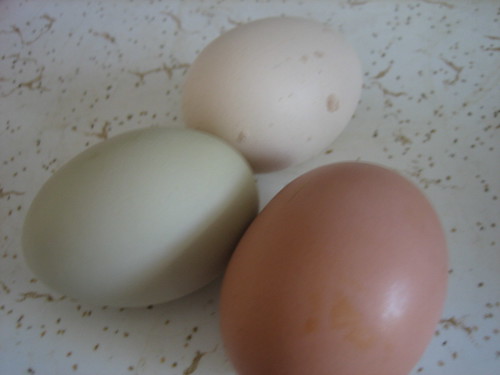
But where do I find these farm-fresh eggs, you might ask? Well, farmers' markets are an excellent place to start. You will probably get the very freshest eggs by doing this. Natural food stores are also a good place to look. Here in Peoria, Greengold Acres (in Hannah City, near Wildlife Prairie Park), is one farm that supplies farm-fresh eggs. Currently, I know that they sell eggs at the Pekin Farmer's Market on Rt. 9, but I swear I read somewhere that they also will be at the Peoria Heights Farmer's Market, which starts in June. However, I discovered, to my delight that, you can purchase their eggs through Naturally Yours, the natural grocery in Metro Centre. The eggs pictured above are all from the same carton.
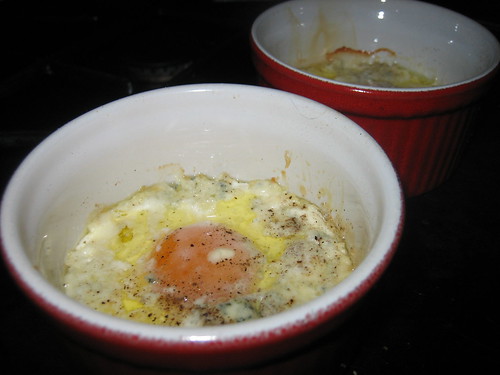 Now, if you've gone through the trouble of getting farm-fresh eggs, you might ask yourself what to do with them. I went for a preparation that would showcase them in their simplicity - shirred eggs. They're quite simple to make, really - just preheat your oven to 375 degrees, and melt some butter in a ovenproof cup or ramekin. Throw in a splash of cream, crack in the egg, and season them with salt and pepper, and maybe a little cheese. I used blue here, but I think that it was overpowering for the delicacy of the egg flavor. Bake the eggs for 15 to 20 minutes, until is is almost set in the center. Enjoy.
The flavor of these eggs was really incomparable, with a grassy, almost floral aroma that I've never noticed in an egg before. I highly recommend seeking out some farm fresh eggs for yourself.


 Posts
Posts