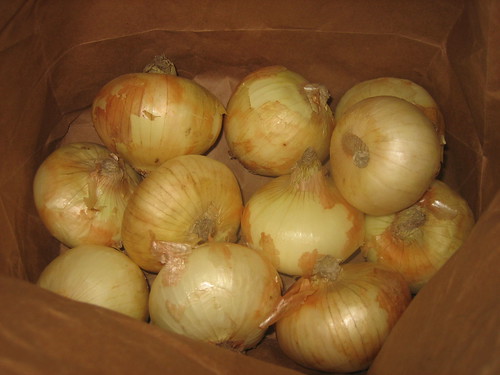
I want to start off by saying that I LOVE onions. If you don't, you probably shouldn't waste your time reading this, but seriously, if you don't love onions, then what the heck is wrong with you?
Onions are one of those vegetables that you will find stretched across the globe, in one form or another. This is partly because onions, properly dried and cellared, keep well, and thus made a useful long-storing crop for the parts of the globe with more temperate climates. Equally important to the onion's success as a food crop, however, would be the strong yet pleasant flavor associated with onions. Certainly, they are an important enough foodstuff that they have had religious symbolism painted on them since the time of the Egyptians.
Obviously, with so many varieties of onion in the world, there are many unique flavors and textures. Certainly, no one would eagerly substitute a shallot for a scallion, or a leek for a Bermuda. But what is it that makes the Vidalia different from all those other yellow onions, like Spanish or Walla Walla's?
Well, first of all, most standard "onions" (white, yellow, Bermuda), are actually quite high in sugar content. This is easily demonstrated by making caramelized onions of any variety. Cook them for long enough over gentle heat, stirring occasionally, and you will be rewarded with a wonderfully sweet and dissolving golden brown mass. Of course, this takes a great deal of time and attention, and all the texture of the onion is lost, as well as most of the "onion-y-ness" inherent to the species.
On the other hand, a raw, or quickly sauteed onion can be quite sharp and pungent. Anyone who has ever taken their knife to one has experienced "onion tears". This is due to the fact that the other thing onions are notably high in is sulfur, which it easily absorbs from the soil. No matter what old wives' tale you try to combat onion tears, the fact is that once you cut an onion, sulfur released from it combines with oxygen to form Sulfur Dioxide, which irritates our mucous membranes, causing tears and sniffling.
Enter the sweet yellow onion family, with several varieties grown in different regions of this country, the aforementioned Walla Walla being one. These onions have been bred to be milder, or in other words, to absorb less sulfur from the soil. This allows your palate to taste more of the sugar, making them appear "sweet".
So why is the Vidalia superior to other types of sweet onion, you might ask? Well, it's got a couple of things going for it that other onions don't. The most important one is that the region of Georgia where Vidalia's are grown has a soil that is uniquely low in sulfur. This means that you taste even more of the natural sugar in the onion than the regular sweets. If an onion is called a Vidalia, it must come from a very specifically defined area that covers about 17 counties in Georgia. Otherwise, it legally cannot be sold as a Vidalia.
Ironically, the other reason that Vidalias are higher quality is because of their name. Let me clarify that statement. Vidalias have been around since the 1930's at least, but it wasn't until 1976 or so that the general American public became aware of them. This is due to the fact that a peanut farmer turned politician had recently won an election. That man, of course, was Jimmy Carter, and he imported Vidalia onions to the White House, bringing them to the general public's attention for the first time. This timing happened to coincide with the explosion of the Nouvelle American cuisine movement, and Vidalia onions became a poster ingredient for the new food movement. Combine that with an extremely limited availability (Vidalias are only harvested between mid-April and June) and suddenly, you have a new gourmet product that the public demands quality from. Since the farmers in the Vidalia region are able to charge a premium price for these onions, they are able to keep quality standards, such as hand harvesting, in place.
All of this combines to continue to make the Vidalia one of the best quality ingredients that is produced for a large scale audience. We are currently in the midst of the Vidalia season, so please, seek them out and enjoy them. One of my favorite things to do with them is onion rings - soak them in buttermilk, then toss in seasoned flour and fry.
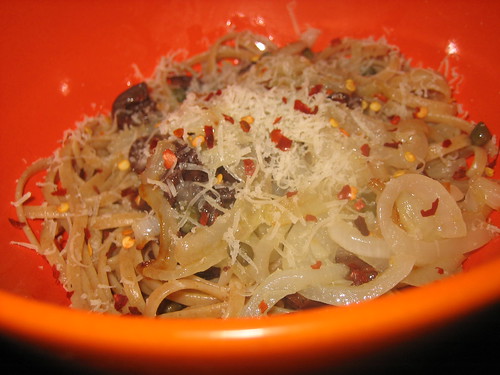
As an alternative suggestion, saute the onions gently in olive oil until they begin to brown. Add a few olives, capers, and some fresh lemon juice, pour over whole wheat pasta, and top with Parmesan reggiano and red pepper flakes for a quick, easy way to enjoy these onions at their finest.


 Posts
Posts