Showing posts with label recipes. Show all posts

Tuesday, May 3, 2011

Granola = Tasty!

Wow, it's been a while since I've updated my blog. I'm making an effort to change that. Since my last blog post, my family's restaurant has been sold and I've added a small but important member to my family. The focus of the blog, however, is going to stay the same. I will also be posting shorter articles at examiner.com as their Farmer's Market examiner, so feel free to check out things over there as well.

Anyway, I'll be starting out with aneasy intro post and recipe. Granola. You may think it's crazy hippy food, or you may find it incredibly delicious. I fall into the latter category. Granola sprinkled on top of yogurt is my go-to breakfast. However, I have a problem with grocery store granola.

1: it's usually loaded with sugar and fat, and in cheaper brands, that fat is often partially hydrogenated and the sugar is high fructose corn syrup, and since I believe that "corn sugar" is in fact inferior to natural sugars, I prefer to avoid it.

2: good quality granola is EXPENSIVE! It can easily run upwards of $10 for a little bag that will last you a week. It certainly doesn't make for an affordable alternative to cereal.

However, the solution to this problem is simple. Make your own granola. It's easier than you may have ever dreamed, and so much cheaper.

I will give credit to Alton Brown for his granola recipe. I use this as the starting point for all of my batches of granola; however, I alter it substantially every time, and pretty much only stick with the measurements of oats and salt - everything else is up for negotiation.

Personally, I try to avoid vegetable oil for a number of reasons, primarily health and flavor. So I substitute butter or coconut oil, generally, for the fat, and I tend to use a bit less - there's no requirement that you have to use that much oil or sugar. So, melt a couple tablespoons of your favorite fat in a saucepan, and then add your sweetener. Now, you can go almost anywhere with sweeteners as well. The more granulated sugar you use, the better your granola will clump together, but if that's not important to you, simply add a tablespoon or two, or forgo it altogether. Flavor will be the determining factor of your other choices of sweetener. I have used evaporated cane sugar, palm sugar, honey, molasses, agave nectar, and maple syrup with good results. Next, add your spices: cinnamon is almostalways a must for me, and a little goes a long way, but I'm also fond of ginger, allspice, nutmeg, and cardamom. Add those in the saucepan and cook until the sugar starts to melt a bit, and you're set!

Of course, you also need to choose what sort of nuts or seeds you'd prefer to see in your granola. Almonds, slivered or whole, hazelnuts, macadamias, walnuts, peanuts, and pecans are all excellent choices; sunflower, pumpkin, sesame, or poppy seeds add unique character; and coconut is a good assertive option. Thechoices you make will have a significant effect on the flavor, as will the decision to add them to the oats before or after cooking - if you purchase pre-roasted nuts or prefer them raw, save it until your granola is out.

Choice of dried fruit is also important, and pretty much limited to whatever you can find - personally, my favorites are cranberries, cherries, blueberries, and dried apricots, but there are plenty of other things to choose from.

So, once you've created your sugar/fat/spice mixture, pour it over your measured granola and nuts and turn until it is well mixed. Spread on a sheet pan, place in a 275 F oven, and stir ever 15 mintues for a total of 1 hour and 15 minutes. Make sure that you have a relatively thin and even layer on your pan or it won't toast evenly. Once you remove it from the oven and cool it a bit, stir in your raw/pre-roasted nuts and fruits, place it in a plastic bag, and you're good to go!

This is my current batch of granola:
IMG_2529.JPG by sesara_adpm
Allspice, cinnamon, ginger, butter, sugar, and maple syrup are the seasonings, and I purchased a "heart healthy" mix of pumpkin seeds, walnuts, almonds, cashews, raisins, and cranberries from Fresh Market. You are only limited to what you can do by your own imagination! Enjoy.

Tuesday, May 12, 2009

Sweeter Side of Spring - Vidalias


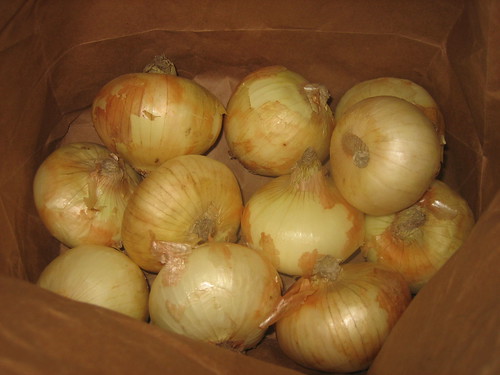
I want to start off by saying that I LOVE onions.  If you don't, you probably shouldn't waste your time reading this, but seriously, if you don't love onions, then what the heck is wrong with you?

Onions are one of those vegetables that you will find stretched across the globe, in one form or another.   This is partly because onions, properly dried and cellared, keep well, and thus made a useful long-storing crop for the parts of the globe with more temperate climates.  Equally important to the onion's success as a food crop, however, would be the strong yet pleasant flavor associated with onions.  Certainly, they are an important enough foodstuff that they have had religious symbolism painted on them since the time of the Egyptians.

Obviously, with so many varieties of onion in the world, there are many unique flavors and textures.  Certainly, no one would eagerly substitute a shallot for a scallion, or a leek for a Bermuda.  But what is it that makes the Vidalia different from all those other yellow onions, like Spanish or Walla Walla's?

Well, first of all, most standard "onions" (white, yellow, Bermuda), are actually quite high in sugar content.  This is easily demonstrated by making caramelized onions of any variety.  Cook them for long enough over gentle heat, stirring occasionally, and you will be rewarded with a wonderfully sweet and dissolving golden brown mass.  Of course, this takes a great deal of time and attention, and all the texture of the onion is lost, as well as most of the "onion-y-ness" inherent to the species.  

On the other hand, a raw, or quickly sauteed onion can be quite sharp and pungent.  Anyone who has ever taken their knife to one has experienced "onion tears".  This is due to the fact that the other thing onions are notably high in is sulfur, which it easily absorbs from the soil.  No matter what old wives' tale you try to combat onion tears, the fact is that once you cut an onion, sulfur released from it combines with oxygen to form Sulfur Dioxide, which irritates our mucous membranes, causing tears and sniffling.  

Enter the sweet yellow onion family, with several varieties grown in different regions of this country, the aforementioned Walla Walla being one.  These onions have been bred to be milder, or in other words, to absorb less sulfur from the soil.  This allows your palate to taste more of the sugar, making them appear "sweet".  

So why is the Vidalia superior to other types of sweet onion, you might ask?  Well, it's got a couple of things going for it that other onions don't.  The most important one is that the region of Georgia where Vidalia's are grown has a soil that is uniquely low in sulfur.  This means that you taste even more of the natural sugar in the onion than the regular sweets.  If an onion is called a Vidalia, it must come from a very specifically defined area that covers about 17 counties in Georgia.  Otherwise, it legally cannot be sold as a Vidalia.

Ironically, the other reason that Vidalias are higher quality is because of their name.  Let me clarify that statement.  Vidalias have been around since the 1930's at least, but it wasn't until 1976 or so that the general American public became aware of them.  This is due to the fact that a peanut farmer turned politician had recently won an election.  That man, of course, was Jimmy Carter, and he imported Vidalia onions to the White House, bringing them to the general public's attention for the first time.  This timing happened to coincide with the explosion of the Nouvelle American cuisine movement, and Vidalia onions became a poster ingredient for the new food movement.  Combine that with an extremely limited availability (Vidalias are only harvested between mid-April and June) and suddenly, you have a new gourmet product that the public demands quality from.  Since the farmers in the Vidalia region are able to charge a premium price for these onions, they are able to keep quality standards, such as hand harvesting, in place.  

All of this combines to continue to make the Vidalia one of the best quality ingredients that is produced for a large scale audience.  We are currently in the midst of the Vidalia season, so please, seek them out and enjoy them.  One of my favorite things to do with them is onion rings - soak them in buttermilk, then toss in seasoned flour and fry.  


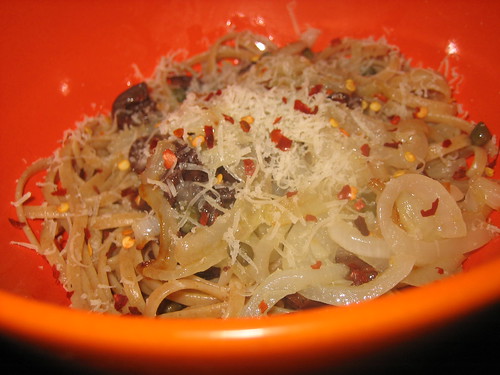
As an alternative suggestion, saute the onions gently in olive oil until they begin to brown.  Add a few olives, capers, and some fresh lemon juice, pour over whole wheat pasta, and top with Parmesan reggiano and red pepper flakes for a quick, easy way to enjoy these onions at their finest. 

Sunday, May 10, 2009

Eggy goodness


Eggs are loved by nearly everyone.  We use them as a stand alone dish, to enrich or emulsify sauces, and as a major ingredient of most of our favorite desserts.  No matter what part of the world you're in, eggs find their way into the local cuisine.

Unfortunately, in recent years, eggs have gotten a bad rap.  Due to the fact that yolks have higher levels of cholesterol than many foods, doctors warned their patients not to eat eggs very often, for fear that their would raise already high cholesterol levels.  Of course, this science turned out to be alarmist and wrong, but the mindset stuck, and millions of Americans still think that eating too many eggs is a dangerous thing, health-wise.  So people stay away from eggs entirely, or eat egg whites to avoid the "bad" parts of the egg.

In actuality, the egg yolk is probably the healthiest part of the egg to imbibe.  Eggs are one of the highest quality sources of protein in existence.  It makes sense if you think about it - eggs contain the components necessary to create a fully living being.  The white is simply the food that being needs to eat while forming.  So please, don't be afraid of your egg yolk.  It's good for you!

Now, this is not to say that all eggs are created equal.  Nutrition and sustainability are still concerns for your eggs.  At the bottom of the totem pole, we have factory farmed eggs.  Yes, they're cheap, but at a cost.  The yolk has the lowest concentration of nutrients, due to the diet that the hens eat.  They're trucked  in from hundreds of miles away, which leads to pollution.  The factory farms on which they're raised also lead to massive levels of chicken waste, hence, more pollution.  The same farms often employ illegal immigrants or use other abusive labor practices, leading to exploitation of their workers just so that you can have a cheap egg.  And finally, the hens that lay the eggs have some of the most miserable lives you can possibly imagine for any animal, as they are kept in a tiny cage for their entire life, and we'll just say that they do some not very nice things to keep them that way.  So, if any of the above things concern you, you may want to consider avoiding conventional eggs.

Now, if you weed out these selections, you're left with a few other grocery choices - organic, omega, brown, cage free, and free range being the most common, and usually found in some combination.  A brief explanation of these terms: organic and omega eggs refer to the diet that the chicken was fed - organic grains, and in the case of omega, flaxseed and other things that will raise the proportion of Omega-3 oils found in the egg yolk.  Brown eggs are simply laid by a variety of chickens that fell out of favor for a while.  There is nothing particularly special about them otherwise.  

Cage-free and free range refer to the fact that the chickens are allowed to roam and peck their food.  Cage free chickens, as the name would imply, are not kept in cages.  However, they still may be kept in an enclosure with hundreds of other chickens, which is less inhumane than cages, but still only a minor improvement.  Free-range means that the chicken had access to the outside - however, this does not mean that the chicken actually gets to walk around looking for its food.  These terms once meant something, but due to corporate pressure on the government to define these terms, one must research the farm to find out exactly how the chickens are actually treated.  

So what's a consumer to do?  Well, due to the locavore food movement, farm fresh eggs are making a comeback.  Most of these farms raise true free-range chickens, which means that the chickens are allowed to roam for their food, which may or may not be supplemented with food by the farmer.  The advantages of buying farm fresh eggs are several.  The eggs are coming from only a few miles, the chickens are being raised in a sustainable (and often, from a pest control standpoint, ecologically friendly) method, the farm labor is usually paid fair wages, and the eggs have a higher nutrient density, as well as a flavor that will be unique to your local area.  

What this means to you as a consumer is that you will probably pay a couple of bucks more for a carton of eggs, but you are getting quality unseen in the grocery store, and you are supporting local agriculture, which is good for your community for the myriad of reasons listed above.  

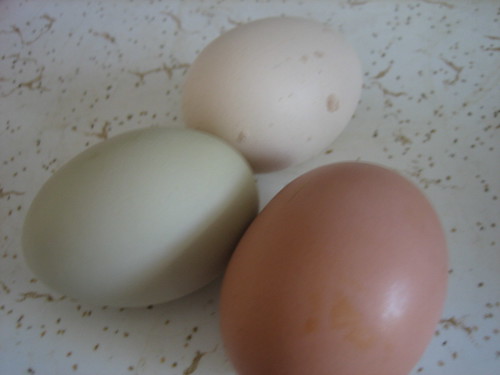
But where do I find these farm-fresh eggs, you might ask?  Well, farmers' markets are an excellent place to start.  You will probably get the very freshest eggs by doing this.  Natural food stores are also a good place to look.  Here in Peoria, Greengold Acres (in Hannah City, near Wildlife Prairie Park), is one farm that supplies farm-fresh eggs.  Currently, I know that they sell eggs at the Pekin Farmer's Market on Rt. 9, but I swear I read somewhere that they also will be at the Peoria Heights Farmer's Market, which starts in June.  However, I discovered, to my delight that, you can purchase their eggs through Naturally Yours, the natural grocery in Metro Centre.  The eggs pictured above are all from the same carton.

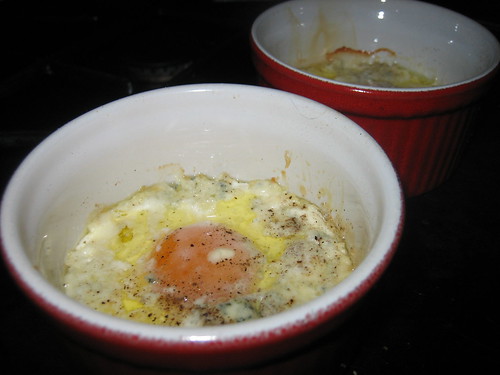
Now, if you've gone through the trouble of getting farm-fresh eggs, you might ask yourself what to do with them.  I went for a preparation that would showcase them in their simplicity - shirred eggs.  They're quite simple to make, really - just preheat your oven to 375 degrees, and melt some butter in a ovenproof cup or ramekin.  Throw in a splash of cream, crack in the egg, and season them with salt and pepper, and maybe a little cheese. I used blue here, but I think that it was overpowering for the delicacy of the egg flavor.  Bake the eggs for 15 to 20 minutes, until is is almost set in the center.  Enjoy.

The flavor of these eggs was really incomparable, with a grassy, almost floral aroma that I've never noticed in an egg before.  I highly recommend seeking out some farm fresh eggs for yourself.

Wednesday, April 29, 2009

Morel Moment

Every spring, they sprout.  From the deep south to the border of Canada, everyone waits for the moment they gauge the conditions to be right, and then the hunt is on.  I am referring, of course, to the morel, among the most prized of wild mushrooms.

Here in Illinois, the season is underway, which you are already well aware of if you are a hunter.  I will admit to being a novice in these matters - this is only my second season hunting for them, but I have already learned a great deal, and expect that experience will hone my skills.  Nonetheless, I will post the necessary disclaimer: DO NOT attempt to hunt morels by yourself without fully educating yourself first; if at all possible, go with someone who DOES know what they're doing before attempting to go on your own.

Ok, now that that's out of the way, I'll get down to business.  The morel is fairly unique in its structure, which makes it easier to identify than many mushrooms.  It is club-shaped, with a honeycombed exterior, and a hollow tube that extends throughout the mushroom.  There are three main varieties - black, grey, and half-free morels.  The half-free morels are considered inferior in flavor to the first two, but are often dried to add a morel flavor to a dish later in the year.  Be sure to educate yourself on how to distinguish false morels, some of which are quite deadly.

The harbingers of the morel season are moist, humid weather and a few good, warm days.  Then, you just need to know where to look.  If you know of any old apple orchards, I would start there, as this seems to be a particularly lush growing area for the mushroom.  Other good places include hardwood forests with dead elms.  I have found that they like growing under blackberry brambles, and have heard stories about finding them in abundance along the banks of streams and creeks.  If you are curious about whether morels are up in your area, there are a couple of great sites you can check out.  Morel Mushroom Hunting has a great map that tracks sightings (in a general area sense) and Morels.com has regional blogs with discussions amongst fellow mushroom hunters.

Morels tend to grow in the same areas year after year, and morel hunters all have their favorite spots.  Don't expect them to tell you where to find such spots though - they tend to be guarded with almost fanatical secrecy.  If you do discover a spot, use a few common sense rules when picking them.  First, if it's a large find, leave a few mushrooms to spore for future seasons.  Second, when picking the mushroom, try to cut it or pinch it off above the base - mushrooms are the fruiting bodies of the plant beneath the surface, and by minimizing the damage to said plant, it is likely that it will produce more fruiting bodies which will again produce more spores.  Many serious morel hunters also put their morels in mesh bags, in order to sow the spores as they walk.

One note - morels for sale.  Most morel hunters never sell their morels.  They only find enough for themselves and maybe a few friends or family, which is just fine.  But there are a few who make serious money off of morels every year.  I have no problem with this - especially as I can obtain wild morels, rather than farmed ones, for my restaurant.  However, some people seem to think that people will pay anything for morels, and set the prices at rather obscene levels.  In the past, I have come across them at Whole Foods for $35/lb and had them offered to me by mushroom hunters for $40/lb.  I consider these prices outrageous, and personally, will not pay more than $20/lb.  But, if you have no way to hunt them yourselves, be aware that they are occasionally for sale.

Once you have found the morels, treating them properly is paramount.  While it is true that mushrooms absorbing water is an old wives' tale,  soaking your morels will remove some of their delicate flavor.  I suggest just brushing them gently to remove loose dirt and cutting them in half to look for errant insects.   If you must wash them, a quick rinse is still a better idea than a long soak.

Morels do contain some toxins, at least according to wikipedia, which are eliminated through cooking.  So as long as you make sure to cook them thoroughly, you should be fine.  

Now, I can think of lots of great uses for morels - battered and fried, in a sauce or stew, or sauteed in a pasta.  But in this, I must defer to my childhood memories for a recipe that I consider perfection, perhaps because of associations with our ritual family Sunday breakfast that my father prepared without fail every week.  I'm not going to give proportions, because I just eyeball this sort of thing anyway.

Morel Omelet  

Morels, cleaned & halved
Asparagus spears, woody ends removed, chopped into 1/2 inch pieces
Vidalia or other sweet onions, sliced thin
goat cheese
Eggs
Butter

Over medium-low heat, saute your onions in melted butter until they begin to soften.  Add your morels, and saute for several minutes more.  Add your asparagus and saute for one or two minutes longer, until the asparagus softens but is still crisp.

In another pan, melt butter over low heat.  Whisk your eggs, salt, pepper, and either a splash of water or milk to thin the mixture slightly.  Pour your mixture into the melted butter and let the eggs begin to set.  With a spatula, gently loosen the edges and tilt the pan while lifting a edge to let the raw egg run underneath.  When the eggs are nearly set, add the sauteed mixture and crumble some goat cheese, and close the omelet.  Cook for just a few moments more and then remove the omelet from the pan.  Serve immediately.